Simple, Ad-Free Apps That Actually Work for Dementia Patients (And How to Use Them Right)

Updated: Jun 3
When “Something to Do” Becomes a Daily Struggle
There’s a moment most caregivers recognize.
You’ve made the calls. Managed the meds. Handled the appointments. And now there’s this quiet stretch of time—where your loved one is restless, bored, or anxious… and you just need something that feels safe, engaging, and manageable.
You try a puzzle: Too complicated. You turn on TV: Too passive. You hand them your tablet or phone… and immediately regret it.
Pop-ups. Ads (and their tiny close "buttons"). Confusion. Accidental taps. Purchases you didn’t approve. It’s not just frustrating—it’s overwhelming.
But here’s the good news: with the right kind of apps (and the right setup), a tablet or phone can become a gentle, engaging tool—not a source of stress.
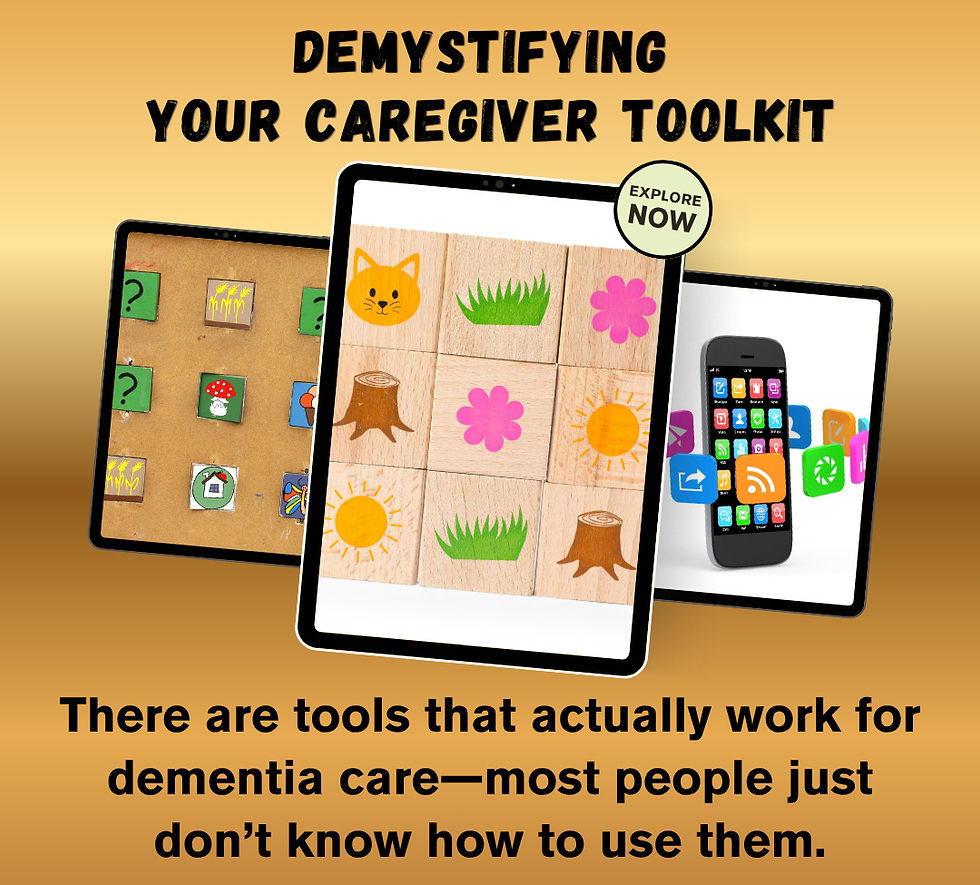
Free vs. Paid Apps: What Caregivers Need to Know
Let’s be honest: “free” apps are rarely truly free.
Most rely on:
Ads (often confusing or intrusive)
In-app purchases (easy to trigger accidentally)
Complex menus or progression systems
For someone with dementia, that’s a recipe for frustration.
Why Paid (or Ad-Free) Often Wins
Paid apps—or free apps with a one-time upgrade—tend to offer:
Cleaner, distraction-free screens
No unexpected pop-ups
Simpler navigation
More predictable interactions
In other words: less cognitive load.
If You Do Use Free Apps
You must set them up first:
Disable in-app purchases (in device settings)
Turn off notifications
Pre-load the app to the correct screen
Use Guided Access (iOS) or Screen Pinning (Android) to lock them into one app
Think of it this way: you’re not handing them a device—you’re creating a controlled environment.
Solo Use vs. Doing It Together
This part matters more than the app itself.
Solo Use (Best for Short Periods)
Good for early-stage independence
Helps fill quiet time
Works best with very simple, repetitive tasks
But expectations should be realistic:
Attention spans may be short
Confusion can happen quickly
Some apps will simply “not click”
Doing It Together (Where the Real Value Is)
This is where apps shine.
Instead of “Here, play this,” it becomes:
“Can you help me find the cat?”
“Which one matches?”
“Let’s do this one together.”
You’re not testing them—you’re joining them.
That shift changes everything:
Less pressure
More connection
Shared moments instead of isolated activity
The Best Simple Activity Apps (iOS + Android)
These apps were chosen for clarity, simplicity, and low frustration risk—not flashiness.
Hidden Folks
Developer: Adriaan de Jongh
Availability: iOS, Android
Summary: A hand-drawn “find the object” experience with calm visuals and gentle sound cues. No timers, no pressure—just exploration.
Cost: One-time purchase (no ads)
June’s Journey
Developer: Wooga
Availability: iOS, Android
Summary: A hidden object game with large, detailed scenes. While it includes a storyline, it can be ignored—simply focus on finding items together.
Cost: Free with ads; optional purchases to remove friction
Busy Shapes
Developer: EDOKI Academy
Availability: iOS, Android
Summary: Drag-and-drop shape sorting with no instructions required. Pure cause-and-effect interaction—ideal for later stages.
Cost: Paid (no ads)
Memory Games: Brain Training
Developer: Maple Media
Availability: iOS, Android
Summary: Simple matching and memory exercises with adjustable difficulty. Best when locked to the easiest level.
Cost: Free with ads; upgrade available
Peak – Brain Training
Developer: Peak Labs
Availability: iOS, Android
Summary: A polished collection of mini-games focused on memory and matching. Clean interface, but best after initial setup.
Cost: Subscription model (limited free version)
NeuroNation
Developer: Synaptikon GmbH
Availability: iOS, Android
Summary: Structured cognitive exercises with predictable formats. Works well for routine-based engagement.
Cost: Free with premium subscription
Colors and Shapes – Sorting Games
Developer: RV AppStudios
Availability: iOS, Android
Summary: Simple color and shape categorization. Repetitive and visual—well suited for mid-to-late stage dementia.
Cost: Free (may include ads)
Word Search Puzzle
Developer: Various (multiple similar versions)
Availability: iOS, Android
Summary: Classic word search format—familiar and comforting. Choose large text and easy difficulty.
Cost: Free with ads; some paid versions available
Wordscapes
Developer: PeopleFun
Availability: iOS, Android
Summary: A slower-paced word-building game. Less overwhelming than many word apps, but still best for early-stage users.
Cost: Free with ads; optional purchases (UPDATE: Ads in free version have become prolific, and difficult to dismiss)
Final Thought: Simplicity Wins Every Time
The goal isn’t to “stimulate the brain” or “improve cognition.”
The goal is simpler—and more meaningful:
Reduce anxiety
Provide gentle engagement
Create small moments of success
And, when possible, share something together
If an app does that—even for five minutes—it’s doing its job.
And if it doesn’t? Move on quickly. No explanation needed.
Because in dementia care, the best tools aren’t the most advanced ones.
They’re the ones that feel easy.


Comments